Wednesday, February 22, 2017

Wednesday, February 15, 2017
How to change RefineryCMS refinery-cms-logo.svg to custom logo (RoR)
I have been searching around the web for quite a bit to find out how I can change the RefineryCMS logo to a custom one. I have volunteered to build a web page for a non-profit organization, and I am also interested to learn Ruby on Rails, so the best way is to embark on a project. This is so that I can get into the thick of it and pick up the skills.
Once RefineryCMS is running it looks like the following picture, the encircled logo belongs to the rails cms.
 I have asked around in the NZ Christchurch ruby slack community, they refereed me to a stack overflow post Adding logo to RefineryCMS nav. I am new to ruby so the answers given in the post do not make sense as I cant find the mentioned file.
But one of the members in NZ Christchurch ruby slack community actually refer to the RefineryCMS documentation about overriding RefineryCms gem pages. Once I get my head around what that means the stack overflow post start to make sense.
This is what I have done with my new understanding.
1) cd into my refineryCMS rails directory
2) execute the following command in the project directory
rake refinery:override view=refinery/*
once the above command is executed you will see the following output being printed in the console.

3) Now if you refresh your project you will see the following files being created.

4) site_bar.html.erb is the file you will be after. The content of the file looks like the following, we will be changing the image_tag
 5) Copy your company or organization's logo into the following path, in my example I intend to display the byars-logo.ico


6) Now modify the previous _site_bar file to the following.
 7) Refresh your refinery page, now you see that the logo has been changed, not looking perfect I agree I will do more modification to it until it looks nice

Once RefineryCMS is running it looks like the following picture, the encircled logo belongs to the rails cms.

But one of the members in NZ Christchurch ruby slack community actually refer to the RefineryCMS documentation about overriding RefineryCms gem pages. Once I get my head around what that means the stack overflow post start to make sense.
This is what I have done with my new understanding.
1) cd into my refineryCMS rails directory
2) execute the following command in the project directory
rake refinery:override view=refinery/*
once the above command is executed you will see the following output being printed in the console.

3) Now if you refresh your project you will see the following files being created.

4) site_bar.html.erb is the file you will be after. The content of the file looks like the following, we will be changing the image_tag


6) Now modify the previous _site_bar file to the following.


Thats all for now till next time.
Wednesday, February 8, 2017
About MuleSoft Session Variables
I have attended the MuleSoft training, and in the training it touched on Session Variables, the training touched the topic of different variables, I understand it but I want to internalize the concepts, so I have created lab experiment about it and have written the results of my findings in Code Project blog.


The MuleSoft documentation is a rich source of information but there is a gap in articulating the behavior of session variables. As developers we understand that session variable is capable of crossing transport but that notion is not true, as per my documented experiment in code project.
In that experiment I found out that session variables only crosses VM transport but not HTTP transport, to understand this I went back to basics, but reading up what session means in the context of computer science. I got an understanding that the Session mechanism can be implemented in any stack of the OSI communications model (show in the diagram below).
Some communication model supports session variable crossing transports, where as some don't. HTTP protocol sits in Layer 7 of the OSI model.
I also got an understanding that in HTTP Sessions, only the server holds session data (which is stored in session variables).

In my experiment when I create a mule flow1 to call another mule flow2 via HTTP endpoint. Now physically both flow1 and flow2 sit in the same mule application, but logically flow1 and flow 2 are essentially treated as different host servers.
If you create a session variable in flow1 and calls flow2 via HTTP endpoint the logical thing to expect the session variable of flow1 will not be accessible by flow2, because logically they are treated as different servers (during run time).

The illustration above will show what you will see logically in your mind, it is as if there are two hows servers, "Logical Server 1" running flow1 and flow3 and "Logical Server 2" running flow2. The Session Variable you have created in flow1 would be able to traverse through to flow3 but not flow2 because it is hosted in "Logical Server 2".
You will have to play around with my lab experiment to be able to better relate to what I am talking about and yes the diagram is an imaginary view, of course you wont see two servers in your Anypoint studio :P. It is there to help you understand what I see in my mind.
Thursday, January 26, 2017
Wednesday, January 25, 2017
Comparing Generic Integration Software Components (MuleSoft v.s X )
Recently I was tasked with a challenge to make a comparison between two integration software, I tried to google about comparison matrices or any models that the industry may have but I found none. As I was also studying TOGAF at the same time, I went on to check and see if there are something of that sort in which I could use to accomplish my mission but I have found none either.
The task lead me to this text book, Enterprise Integration Patterns written by Gregor Hohpe and Bobby Woolf. In the book they talk about the generics building blocks of an integration software.

I have worked with other integration software bundles before so from my experience I try to the best of my effort to come up with a generic model, as shown in the following diagram.

I stand to be corrected and I might not have the complete picture of all the constituent components that makes up an integration software, but this my best effort.
As we are moving to cloud based architectures, there are integration components that runs in the cloud which is as illustrated, and there are hybrid components that can both be implemented on the cloud or on premise, the blue box are the bundle of components that have this hybrid option of either to be implemented in the could or on premise.
With this model in mind I have come up with the following comparison matrix.I have populated the Mulesoft column, the other column highlighted in orange is for you to fill up the fetures of any other integration software.

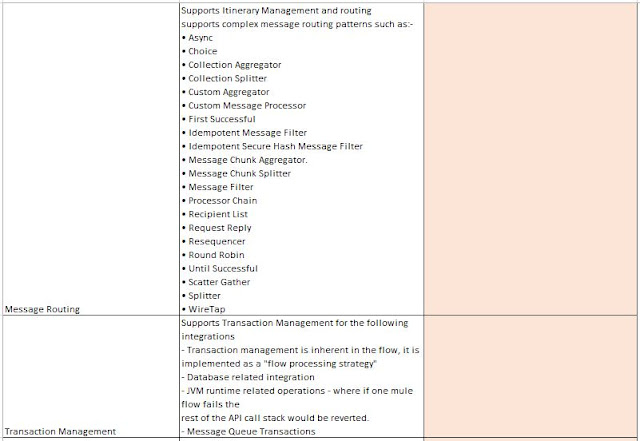


Like I said I might have missed out some components but this exercise really gives me a good revision of MuleSoft's offerings and it's features.
Tuesday, January 24, 2017
Mule-soft Champions Web Site
After passing my MuleSoft certified associate certification I was immediately subscribed to the “Champions Programme”. I didn’t know what it was about so I ignored the registration mail and didn’t really pay attention to it for 1 to 2 weeks.
One evening as I open up the mail, I clicked on the link and was brought immediately to the “Champions Website”, before I talk about champions web site, the first time I experience developing integration in MuleSoft is via the first “MuleSoft certified associate” training, and once I have finished the training I am hooked to MuleSoft I want to know more, I want to work on the product, I want to create stuff, roll my sleves up and start building solution, making changes that will help people, businesses and organizations, I find that I need to know more about MuleSoft development.
So as I head into the champions web site I found that Mulesoft have gamified the whole learning continuous community connection and learning process for MuleSoft and I like it.
At the point of this writing generally the web site has 3 navigational section that is worth our attention. They are namely
- My Challenges – Where you can choose and pick what challenges you want to take on, and if you successfully complete the challenge, you will then accumulate points, the points that you have accumulated will then allow you to redeem gifts at the reward stores.
- Discussions – Is where you can post and view other mulesoft developer’s post on a topic of discussion, you can answer the discussion or ask question about a discussion.
- Reward Store- This is the beauty of the whole gamification, here is where you can redeem stuff with the points you have accumulated from winning the challenges.

On the left hand pane of the champions web site you will also see a “Leaderboard” where it shows who is leading in terms of points accumulation.
Its not just all work and no play there are challenges that are fun and has nothing to do with MuleSoft at all, these are the challenges where you can do when you need a break. This whole web site is addictive.
And the most noble thing of all about the champions web site is that it allows the players to get a shot at higher education, it allows the mulesoft development community to persue futher education in development of mulesoft solution.
If you navigate into the rewards section there are many type of rewards, you have the mulesoft t-shirts, the max mule soft toy, the storm trooper helmet and the most Nobel of all the gift is the chance to a higher education, which I am aiming for, as I want to know more about the MuleSoft product.

There are so many strategy to get a complete education into MuleSoft to continue your persuit of mastering the development skills, to accumulate the points you can answer question on stack overflow or speak at a mulesoft event.

Or you could create tutorial videos about mulesoft development.

You could publish a blog about mulesoft , that will get you 1000 points do it 15 times and you will get your education ticket, but what you didn’t realize is tha writing a blog, talking about it and recording videos are chances for you to review and revised what you already know about the product, and it helps you absorb even more knowledge when you go for the actual course.

This is the most brilliant idea to get the MuleSoft development community together, on top of it being a fantastic integration product this Champions website is just here to glue all of use mule devs together to learn, discuss and innovate to make it an even better product.
Its Brilliant !!!!
Thursday, January 19, 2017
Subscribe to:
Posts (Atom)